

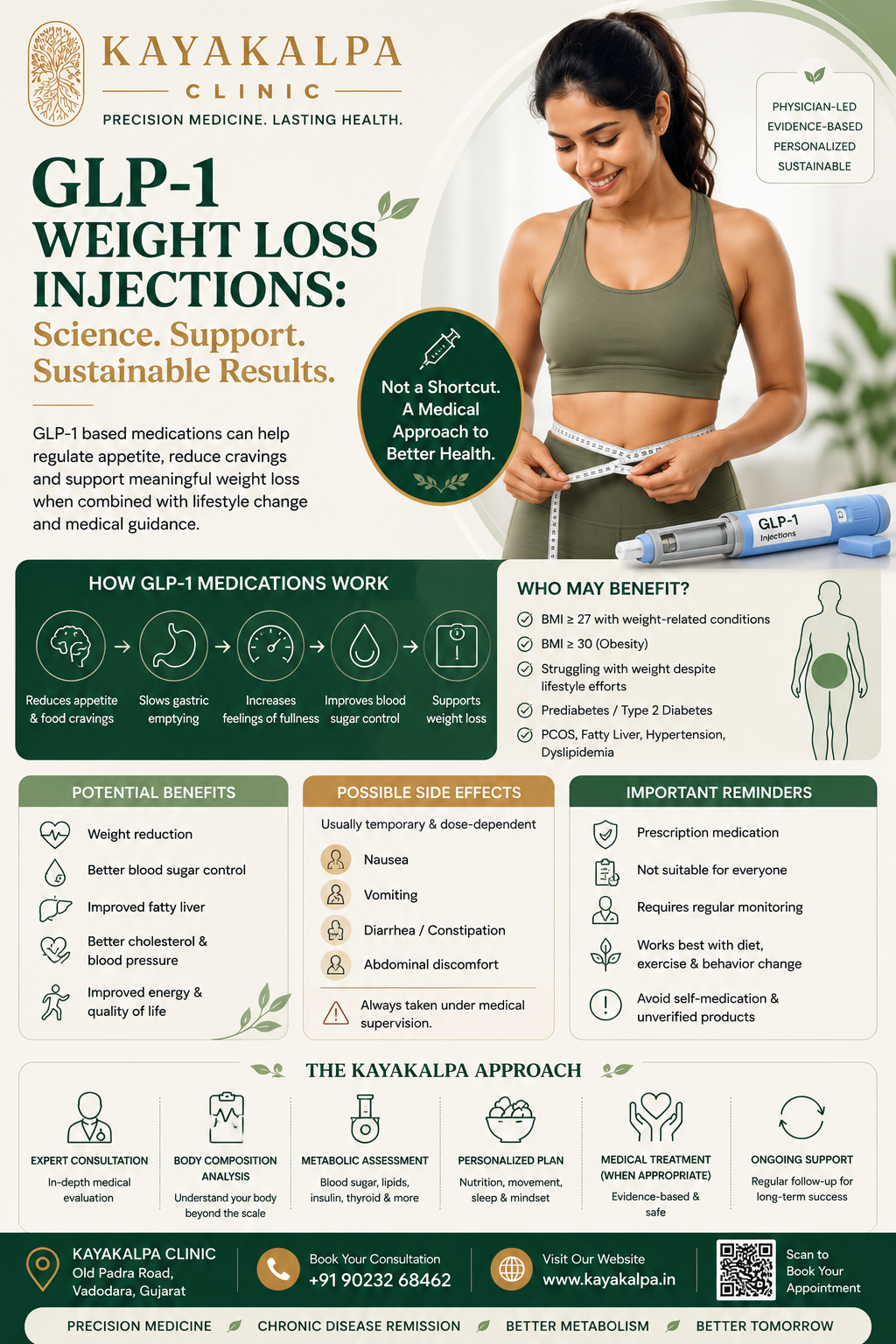
If you’ve been following the latest developments in weight management, you’ve probably heard about GLP-1 weight loss injections.
Medications such as semaglutide and tirzepatide have changed the conversation around obesity treatment. But social media often makes these medications sound like a simple shortcut to weight loss.
The reality is more nuanced.
GLP-1-based medicines can be highly effective for appropriately selected patients, but they are prescription medicines, they have potential side effects and contraindications, and they should be used as part of a comprehensive weight-management plan.
The World Health Organization’s 2025 guidance recognizes GLP-1 therapies as one option for long-term treatment of obesity in adults, while emphasizing healthy eating, physical activity and professional support as part of comprehensive care.
At Kayakalpa Clinic in Vadodara, the decision to use medication begins with understanding the individual’s health, metabolic risk, weight history and treatment goals.
What Are GLP-1 Weight Loss Medications?
GLP-1 stands for glucagon-like peptide-1, a hormone involved in appetite regulation and blood glucose control.
GLP-1 receptor agonists mimic some of the effects of this naturally occurring hormone.
They can:
- Increase feelings of fullness
- Reduce appetite
- Slow gastric emptying
- Help regulate blood glucose
- Reduce food intake
Tirzepatide is slightly different. It acts on both GIP and GLP-1 pathways, which is why it is often described as a dual GIP/GLP-1 receptor agonist.
Semaglutide vs Tirzepatide: What’s the Difference?
Two names frequently discussed in medical weight management are semaglutide and tirzepatide.
Semaglutide
Semaglutide is a GLP-1 receptor agonist used in specific formulations for diabetes and chronic weight management.
Tirzepatide
Tirzepatide activates both GIP and GLP-1 receptors.
For example, the U.S. FDA approved tirzepatide under the brand Zepbound for chronic weight management in adults with obesity, or adults with overweight plus at least one weight-related condition, alongside a reduced-calorie diet and increased physical activity.
Important: Brand names, approvals, prescribing criteria and availability can vary by country. A medication should only be prescribed based on the patient’s individual medical circumstances and the applicable local regulatory guidance.
How Do GLP-1 Medicines Help With Weight Loss?
One reason these medicines can be effective is that they influence the biological systems involved in hunger and satiety.
Instead of simply telling someone to “eat less,” treatment can help some patients experience:
Less hunger → better appetite control → lower food intake → gradual weight loss
This can be particularly relevant for people who have struggled with persistent hunger, food cravings or repeated weight regain despite sustained lifestyle efforts.
However, response varies considerably between individuals.
re GLP-1 Injections Suitable for Everyone?
No.
This is one of the most important messages patients should understand.
A high body weight alone does not automatically mean someone should receive a GLP-1 medication.
Prescription weight-management medicines are generally considered for people with overweight or obesity when lifestyle interventions alone have not produced sufficient improvement and when the potential benefits outweigh the risks. Specific eligibility criteria depend on the medication and local prescribing guidance.
A doctor may consider:
- BMI
- Waist circumference
- Existing medical conditions
- Diabetes or prediabetes
- Blood pressure
- Cholesterol
- Previous weight-loss attempts
- Current medications
- Pregnancy plans
- Medical history
- Treatment goals
GLP-1 Medication Is Not a Replacement for Lifestyle
This is perhaps the biggest misconception surrounding weight-loss injections.
Medication does not replace healthy eating, physical activity, sleep or behavioral change.
Evidence-based guidance recommends combining weight-management medication with lifestyle interventions.
At Kayakalpa, the objective isn’t simply:
“Take an injection and lose weight.”
Instead, the approach is:
Medical assessment + appropriate treatment + nutrition + movement + behavior + monitoring
That is what makes medical weight management different from a quick-fix weight-loss program.
What Happens When You Stop the Medication?
Another important question is whether weight stays off after stopping treatment.
Weight regain can occur after discontinuing weight-management medication. NIDDK notes that people may regain some weight after stopping treatment, which is one reason long-term weight management needs to include sustainable eating and physical-activity habits.
This doesn’t mean the medication has “failed.”
Rather, it highlights an important principle:
Obesity is a chronic condition, so weight management often requires long-term care.
The appropriate duration of treatment should be discussed with a physician based on response, benefits, side effects and individual circumstances.
What Are the Possible Side Effects?
GLP-1-based medicines commonly cause gastrointestinal symptoms.
These may include:
- Nausea
- Vomiting
- Diarrhea
- Constipation
- Abdominal discomfort
WHO notes that gastrointestinal side effects are common and that more serious gastrointestinal and other complications have also been associated with these therapies and continue to be evaluated.
This is why taking these medicines without medical supervision is not advisable.
Your doctor needs to consider your medical history, other medications, dose escalation and any symptoms that develop during treatment.
Why Buying Weight-Loss Injections Without Medical Advice Is Risky
The growing popularity of GLP-1 medicines has also increased demand for products obtained outside appropriate medical and pharmacy channels.
This creates several concerns:
- Incorrect medication
- Incorrect dosing
- Drug interactions
- Unrecognized contraindications
- Poor-quality or falsified products
- Inadequate monitoring
WHO has specifically warned about the spread of falsified and substandard GLP-1 products and emphasizes regulated distribution and prescribing by qualified healthcare professionals.
A weight-loss injection is still a prescription medicine — not a cosmetic product.
What Does a Medical Weight-Loss Consultation Include?
At a physician-led weight-management clinic, treatment should begin with assessment rather than immediately starting medication.
At Kayakalpa Clinic, Vadodara, evaluation may include:
Medical History
Understanding your weight trajectory, previous diets, medications and existing conditions.
Metabolic Assessment
Depending on your clinical situation, this may include blood glucose, HbA1c, lipids and other relevant investigations.
Body Composition
Understanding body fat, muscle mass and other body-composition parameters can provide more information than body weight alone.
Lifestyle Assessment
Nutrition, physical activity, sleep, stress and eating patterns all matter.
Treatment Planning
Based on your individual profile, your doctor can discuss lifestyle interventions and, when clinically appropriate, medication options.
Can GLP-1 Treatment Help With More Than Weight?
Weight management is closely connected with metabolic health.
For people with obesity or overweight and related health conditions, meaningful weight loss may help improve several cardiometabolic risk factors.
For example, weight reduction can support improvements in:
- Blood glucose
- Blood pressure
- Triglycerides
- Fatty liver risk
- Physical mobility
- Sleep-related problems
The specific benefits depend on the individual and the treatment used.
GLP-1 Therapy at Kayakalpa: A Personalized Approach
At Kayakalpa Clinic, the focus is not on prescribing the newest medication to everyone.
The question is:
“What does this patient actually need?”
For some patients, lifestyle intervention may be sufficient.
For others, medication may be appropriate.
Some may need evaluation for thyroid disease, insulin resistance, PCOS, diabetes, sleep problems or other contributors to weight gain.
This is why medical weight management should be individualized.
Who Should Consider a Medical Weight-Loss Consultation?
Consider speaking with a doctor if you:
- Have obesity or excess weight affecting your health
- Have repeatedly regained weight after dieting
- Have prediabetes or Type 2 diabetes
- Have PCOS with metabolic concerns
- Have fatty liver disease
- Have high blood pressure associated with excess weight
- Have struggled with persistent hunger or appetite control
- Want to understand whether medication is medically appropriate for you
Looking for GLP-1 Weight Loss Treatment in Vadodara?
If you’re searching for:
GLP-1 weight loss injections in Vadodara
Medical weight loss in Vadodara
Weight loss doctor in Vadodara
Obesity treatment in Vadodara
Weight loss clinic in Vadodara
Metabolic physician in Vadodara
Kayakalpa Clinic provides physician-led weight-management care focused on Precision Medicine, Lifestyle Medicine and Metabolic Health.
The goal is not rapid weight loss at any cost.
The goal is better health that lasts.Frequently Asked Questions
Are GLP-1 injections safe?
They can be appropriate for selected patients when prescribed and monitored by a qualified healthcare professional. They are not suitable for everyone and can cause side effects.
Do GLP-1 injections permanently cure obesity?
No. Obesity is a chronic condition, and long-term management may be required. Weight can return after medication is stopped.
Can I take GLP-1 medication without changing my diet?
Medication should not be considered a substitute for healthy eating and physical activity. Comprehensive lifestyle intervention remains an important part of treatment.
Are GLP-1 medicines suitable for people with diabetes?
Some GLP-1-based medicines are used in diabetes management, while certain formulations are approved for chronic weight management. The appropriate medication depends on the patient’s diagnosis and clinical situation.
Can everyone who wants to lose weight take a GLP-1 injection?
No. A doctor should assess whether the medication is appropriate based on medical history, weight-related health risks, other medications and potential contraindications.